Unknown's avatar

About Gary Nilsen

I'm a writer. I have a lot of things to say - sometimes I like to tell stories and those show up in the books I write. Sometimes I get angry or frustrated by the things I see in the news, so comments about these will be showing up on this blog. Social injustice is the spark to my fuse... I live in New York with my family and two Old English Sheepdogs. I've lived in far off places - the Kingdom of Saudi Arabia, and have been fortunate to visit many other parts of the world. Stay tuned...

When Does a Right become a Right?

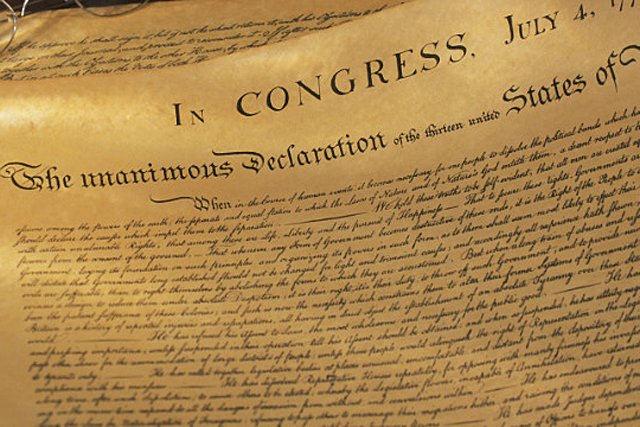
declaration-of-independence-1

Slavery officially ended, at least on the books in America, in 1863. The 19th Amendment finally ended decades of struggling, allowing women the right to vote. Now, in 2015, gays received a federal blessing with the removal of restrictions on same-sex marriage. All were celebrated as victories for the activists trying to push these agendas toward mainstream acceptance. The question is why did they have to fight for them in the first place?

Rights come in two varieties: natural and legal. Jefferson’s preamble to the Declaration of Independence creates the platform by which the United States would assert their liberation from the tyranny of Great Britain by saying that we are all born with natural rights – life, liberty and the pursuit of happiness. Legal rights are those created under social contract theory – the fundamental balance between what rights people surrender in return for the benefits of a larger and orderly society.

Therein lies the problem.

Take a survey of all our systems of law: common law, civil law, criminal law, corporate law, real estate law, biblical law, maritime law, tax law, Hammurabi’s code, you might even consider the Ten Commandments. Over the last six thousand years, we’ve been so busy legislating what people can and can’t do that we’ve lost sight of what simple, natural rights look like. At best, we have some semblance of civilization (not really – just read the news every day). At worst, we have global disparity and the polarization of people over every belief, custom, and way of life.

It comes down to agendas. Get enough people together with a similar agenda and the life of a natural right is threatened. It’s the might-makes-right sickness. News flash: the majority IS NOT always right. There should never have been a law restricting same-sex marriage. If two people find a connection with another of the same-sex, how can anyone honestly object? Why should anyone care if two women kiss, or two men hold hands? It’s a natural right. Why don’t women receive equal pay? It’s a natural right. Instead of voting for new laws, we should be looking more toward removing statutes, especially the ones that offer benefits to smaller segments of society to the deficit of everyone else. (IRS, are you listening?) We should be re-examining the ways in which our society is suppressing our natural rights.

My fifteen-year-old son, Ian, phrased it correctly for me. He said: “how embarrassing humans are to have just allowed gay marriage, instead of how it should’ve been a human right from the beginning.”  So today, on this July 4th, I can rest thinking that perhaps there is some hope for the future after all.

A House Divided…

hqdefault

In June of 1858, Abraham Lincoln won the candidacy for the Republican Party in the Presidential race. He addressed over a thousand people that evening with a now famous speech that, in part, spoke of the rift caused by slavery. He quoted the bible: “A house divided against itself cannot stand.”

A hundred-fifty years have passed since Appomattox, and we seem to have come full circle. South Carolina is once again the center of controversy (the recent shootings in Charleston were, figuratively, a stone’s throw from Fort Sumter), and the ignominious face of racism has been unmasked, once more. We’re still dealing with the shame and arrogance of the Confederate flag, economic and political issues divide the nation, and terrorism runs rampant throughout the country as it did in the decades leading up to the Civil War. In the 1830s, there were upwards of 115 riots in the then major urban centers, and reports of lynchings were commonplace.

How sad is it to discover that we have learned nothing? For all our advances in medicine, technology, and science, we are still standing on the same foundation of the house that burned to the ground in the most catastrophic domestic war in our history. The Ku Klux Klan, formed in the aftermath of that war, during the so-called Reconstruction, still wreaks havoc. Its influence has spawned more than a dozen other white supremacist organizations, which are just as guilty of radicalizing our young minds as ISIS is.

Historically, I’m amazed that other, stronger nations of the period, like France or England, didn’t capitalize on our weaknesses then and attempt to absorb our nation into their empires. We may not be so fortunate the next time around. China and Russia are both posturing with imperialistic intent, both militarily and economically, and we are insolent enough to assume that we can withstand all-comers.

To borrow a quote from economist, John Maynard Keynes: “The difficulty lies not so much in developing new ideas as in escaping from old ones.” So how do you eradicate the truly pervasive and deep-rooted notions of racism and prejudice? You can’t undo the teaching of hate, you can’t legislate against it, civil wars don’t eradicate it – in fact, it probably exacerbates it, and you can’t go around shooting people who stand at the root of it all, though the temptation to do so might be appealing. Unfortunately, that would put all of us in the same category as Dylann Roof. Don’t laugh, Charles Cotton, moron extraordinaire and board member of the NRA said that if more people carried guns, nine people might not have died in Bible study class. I kid you not!

Racism is but one of many divides in our country. Politics, always a detestable and unpalatable subject, has practically unraveled to the point of political civil war, and any unifying force seems as remote as the Andromeda galaxy. If a Democrat says the sky is blue, the Republicans will pronounce it will ruin the economy. Economics: Republicans, Super PACs, and the 1% on the right; Democrats, the dwindling middle class, immigrants, and the common American on the left. How are you going to solve that one? I don’t even want to think about the Tea Party. Gays vs anti-gays, blacks and Jews vs white supremacists, Bible-thumping creationists vs the scientists, war-mongers vs the isolationists, union vs non-union, humanitarian aid vs ‘it’s not my problem’ types, or pick any other one you want, the list is inexhaustible.

Is leadership the answer? Right now, there appears to be only two voices out there that seem to make any sense: The Pope and Bernie Sanders. Since the former isn’t eligible for the presidency on any level, this leaves Mr. Sanders – who could possibly take the Republican Party seriously at this point. It’s a long road to next November. I’m not sure if leadership will help since whoever is elected will be hated by virtually fifty percent of the people.

In a recent post on racism, I said the only solution to curbing that problem lies within each of us, individually and the choices we make. I lack the faith that this notion will work in practice for the legion of problems we face. Meanwhile, I hear the timbers around me starting to crack inside my divided house. Anyone out there know a good carpenter? I can imagine someone making the corollary that Jesus was a carpenter. Well, if the guy was as good as so many people believe he was, then this might be a good time for him to make a pit-stop.

Diversity is the cultural norm of the United States, and the Constitution guarantees freedom of speech and religion, but there is a price. Diversity is the root of all conflict. It sparks the fuse of superiority and entitlement and explodes in a miasma of hate.

Racism is alive and well…

put_the_hate_down_poster-r6f1c68b4333544c1b1a8a36d10b8632c_wqa_8byvr_324

How many more incidents need happen before we fully acknowledge that racism is still a part of our culture? South Carolina, where the most recent atrocity took place, still flies the Confederate stars and bars of the Southern Cross; it’s not even lowered at half-mast. In Kansas, a black lawmaker is facing possible disciplinary measures because she used “inflammatory” language in referring to supporters favoring the elimination of tuition breaks for undocumented immigrants as being racist. Blacks are claiming strong racist sentiment as the underlying cause for the shooting of Freddie Gray and the resulting riots in Baltimore. The statistics being kept for the number of ‘deaths by cop’ show that nearly half were minorities. The fear factor is rising on both sides of the equation. Blacks and minorities fear that it’s more likely to be shot and killed by police (especially while unarmed – nearly a third of the blacks killed had no weapon) and the police are wary of reprisals which only serves to make them more trigger-happy, as was evidenced by the officer involved in the Texas pool party incident – he didn’t fire his weapon, but he did train it on a couple of other teens to get them to back up.

The vacillating argumentation on racism, even as it exists today, would fill volumes upon volumes of books and newspapers. White supremacist organizations are as strong as they ever were, and just as vile. After the murders in Charleston, another bigot in Virginia was threatening violence against another black church.

My first experience with racism came in 1967. I was raised in the predominantly white neighborhood of Bay Ridge in Brooklyn (it has changed considerably since then). We had any number of children come through our school because Fort Hamilton was close by, and they came to our building while stationed there. At one point, it was decided that some of the under privileged schools would send some of their students to us for classes; they were to be bused in. I was in seventh grade and a member of the school safety program, which meant I helped the teachers monitor the students as they lined up with their class to then walk up the stairs to their rooms. The first day one of those busses arrived, an entire class of African-American boys and girls lined up in the gym. One boy in particular was stepping out of line and being very disruptive, so I walked over and touched his shoulder , asking that he please step back in line. He whirled on me and said: “Don’t touch me, I’m black”. I was stunned. Up to that moment, I’d never experienced anything like that. I really had had no understanding that one racial group could have an attitude toward another simple because of the color of their skin. But, it was a subject that was going to grab hold, for us all, in the months that followed.

I think the prevailing notion is that since the days of Martin Luther King, Robert Kennedy, George Wallace, and Malcolm X that significant inroads have been made to eliminate racism and prejudice. There probably have been, but it’s also fair to say, that it hasn’t gone away, and it never will. This is clearer by the moment, and racism isn’t just limited to black people, it’s flowing over to Muslims, still includes Jewish people, and certainly extends to the people of Mexico and all points south who desperately try to immigrate here. Oh, and let’s not forget the LGBT community – it’s still quite dangerous in parts of the country for homosexuals to take a breath.

Okay, so let’s face it. Try as we might: we can legislate, educate, and proselytize equal rights and tolerance. It simply isn’t going to happen. If we haven’t found a solution in at least the six thousand years we’ve been struggling with this, how can we expect to find a way to do it now? So, what next? What possible solutions can there be to allow for peaceful co-existence? How do we get whole communities and organizations to back off in order to reset the levels of rage and despair to the point where communication is even feasible again?

As I see it, it comes down to individual responsibility; to take that moment to rise above ignorance, to engage in a cease-fire from any personal agenda in projecting hate. It requires the self-discipline of stopping, thinking, and rationalizing before taking action, and this has to happen on all sides. Seeing a black person on a subway platform, strutting his attitude, showing off tattoos and sideways baseball caps, with rap music blaring from their Dr. Dre’s can be just as intimidating for some as a redneck with a bandana and a black tee shirt with a swastika blazoned across the chest can be. Attitude breeds fear, and fear drives pre-emptive retaliation where none is called for. We can’t rid the human brain of racism, prejudice, and intolerance, but hopefully we can learn to co-exist.

Everyone take a deep breath.