When Does a Right become a Right?

declaration-of-independence-1

Slavery officially ended, at least on the books in America, in 1863. The 19th Amendment finally ended decades of struggling, allowing women the right to vote. Now, in 2015, gays received a federal blessing with the removal of restrictions on same-sex marriage. All were celebrated as victories for the activists trying to push these agendas toward mainstream acceptance. The question is why did they have to fight for them in the first place?

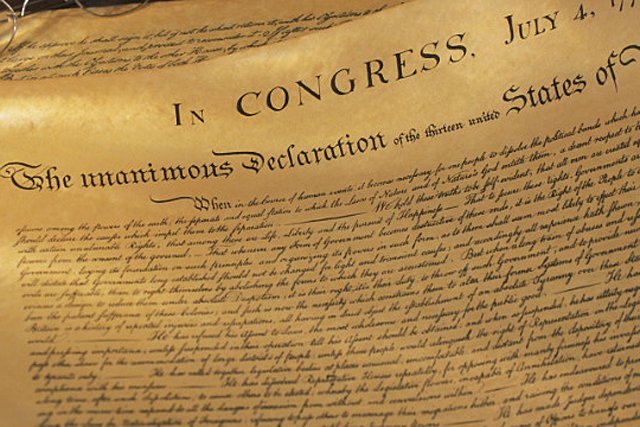
Rights come in two varieties: natural and legal. Jefferson’s preamble to the Declaration of Independence creates the platform by which the United States would assert their liberation from the tyranny of Great Britain by saying that we are all born with natural rights – life, liberty and the pursuit of happiness. Legal rights are those created under social contract theory – the fundamental balance between what rights people surrender in return for the benefits of a larger and orderly society.

Therein lies the problem.

Take a survey of all our systems of law: common law, civil law, criminal law, corporate law, real estate law, biblical law, maritime law, tax law, Hammurabi’s code, you might even consider the Ten Commandments. Over the last six thousand years, we’ve been so busy legislating what people can and can’t do that we’ve lost sight of what simple, natural rights look like. At best, we have some semblance of civilization (not really – just read the news every day). At worst, we have global disparity and the polarization of people over every belief, custom, and way of life.

It comes down to agendas. Get enough people together with a similar agenda and the life of a natural right is threatened. It’s the might-makes-right sickness. News flash: the majority IS NOT always right. There should never have been a law restricting same-sex marriage. If two people find a connection with another of the same-sex, how can anyone honestly object? Why should anyone care if two women kiss, or two men hold hands? It’s a natural right. Why don’t women receive equal pay? It’s a natural right. Instead of voting for new laws, we should be looking more toward removing statutes, especially the ones that offer benefits to smaller segments of society to the deficit of everyone else. (IRS, are you listening?) We should be re-examining the ways in which our society is suppressing our natural rights.

My fifteen-year-old son, Ian, phrased it correctly for me. He said: “how embarrassing humans are to have just allowed gay marriage, instead of how it should’ve been a human right from the beginning.”  So today, on this July 4th, I can rest thinking that perhaps there is some hope for the future after all.


A House Divided…

hqdefault

In June of 1858, Abraham Lincoln won the candidacy for the Republican Party in the Presidential race. He addressed over a thousand people that evening with a now famous speech that, in part, spoke of the rift caused by slavery. He quoted the bible: “A house divided against itself cannot stand.”

A hundred-fifty years have passed since Appomattox, and we seem to have come full circle. South Carolina is once again the center of controversy (the recent shootings in Charleston were, figuratively, a stone’s throw from Fort Sumter), and the ignominious face of racism has been unmasked, once more. We’re still dealing with the shame and arrogance of the Confederate flag, economic and political issues divide the nation, and terrorism runs rampant throughout the country as it did in the decades leading up to the Civil War. In the 1830s, there were upwards of 115 riots in the then major urban centers, and reports of lynchings were commonplace.

How sad is it to discover that we have learned nothing? For all our advances in medicine, technology, and science, we are still standing on the same foundation of the house that burned to the ground in the most catastrophic domestic war in our history. The Ku Klux Klan, formed in the aftermath of that war, during the so-called Reconstruction, still wreaks havoc. Its influence has spawned more than a dozen other white supremacist organizations, which are just as guilty of radicalizing our young minds as ISIS is.

Historically, I’m amazed that other, stronger nations of the period, like France or England, didn’t capitalize on our weaknesses then and attempt to absorb our nation into their empires. We may not be so fortunate the next time around. China and Russia are both posturing with imperialistic intent, both militarily and economically, and we are insolent enough to assume that we can withstand all-comers.

To borrow a quote from economist, John Maynard Keynes: “The difficulty lies not so much in developing new ideas as in escaping from old ones.” So how do you eradicate the truly pervasive and deep-rooted notions of racism and prejudice? You can’t undo the teaching of hate, you can’t legislate against it, civil wars don’t eradicate it – in fact, it probably exacerbates it, and you can’t go around shooting people who stand at the root of it all, though the temptation to do so might be appealing. Unfortunately, that would put all of us in the same category as Dylann Roof. Don’t laugh, Charles Cotton, moron extraordinaire and board member of the NRA said that if more people carried guns, nine people might not have died in Bible study class. I kid you not!

Racism is but one of many divides in our country. Politics, always a detestable and unpalatable subject, has practically unraveled to the point of political civil war, and any unifying force seems as remote as the Andromeda galaxy. If a Democrat says the sky is blue, the Republicans will pronounce it will ruin the economy. Economics: Republicans, Super PACs, and the 1% on the right; Democrats, the dwindling middle class, immigrants, and the common American on the left. How are you going to solve that one? I don’t even want to think about the Tea Party. Gays vs anti-gays, blacks and Jews vs white supremacists, Bible-thumping creationists vs the scientists, war-mongers vs the isolationists, union vs non-union, humanitarian aid vs ‘it’s not my problem’ types, or pick any other one you want, the list is inexhaustible.

Is leadership the answer? Right now, there appears to be only two voices out there that seem to make any sense: The Pope and Bernie Sanders. Since the former isn’t eligible for the presidency on any level, this leaves Mr. Sanders – who could possibly take the Republican Party seriously at this point. It’s a long road to next November. I’m not sure if leadership will help since whoever is elected will be hated by virtually fifty percent of the people.

In a recent post on racism, I said the only solution to curbing that problem lies within each of us, individually and the choices we make. I lack the faith that this notion will work in practice for the legion of problems we face. Meanwhile, I hear the timbers around me starting to crack inside my divided house. Anyone out there know a good carpenter? I can imagine someone making the corollary that Jesus was a carpenter. Well, if the guy was as good as so many people believe he was, then this might be a good time for him to make a pit-stop.

Diversity is the cultural norm of the United States, and the Constitution guarantees freedom of speech and religion, but there is a price. Diversity is the root of all conflict. It sparks the fuse of superiority and entitlement and explodes in a miasma of hate.

The Supreme Court: Duped, except for one…

Laughing all the way...

Laughing all the way…

On June 1st, the Supreme Court rendered a decision favoring a girl by the name of Samantha Elauf over retailer Abercrombie & Fitch. News coverage was widespread, and nearly every publication I read had virtually the same recital of the facts.

Simply stated, this young Muslim woman applied for a position at Abercrombie in 2011. The assistant manager felt she was an excellent candidate, but both he and the store manager were concerned that her wearing of a hijab would fail to exemplify the stores “look policy”. Her application was thus declined. Enter the EEOC (Equal Employment Opportunity Commission). The arguments of the case went back and forth on the technicalities of who knew what when. Ultimately, Elauf was awarded $20,000. The Court of Appeals overturned it, and the case wound up going all the way to the Supreme Court.

Here’s the thing that gets me. Elauf, according to her LinkedIn page, was employed by retailer Forever 21as a Visual Merchandising Manager from 2008 to 2015. So, being in the business means that she had to be familiar with the culture and style of Abercrombie; just look at their ads and their shirtless staff. Why would a girl with her upbringing and religious persuasion want to work in a store that goes against her grain? This point was also brought out by fellow blogger Pamela Geller – the woman who brought you Garland, Texas. If she was gainfully employed at the time, why did she just happen to pursue a change in jobs to Abercrombie? This year she finally did move to Urban Outfitters, but not before leaving a ruckus in her wake.

This is contrivance in its purest form. This is not a win for the freedom of religious expression. This is not a win for equal opportunity. This is not a win for social justice or discrimination. This is religion being forced down our throats. Do I approve of the style of Abercrombie? Not really. I remember the days when it was an amazing purveyor of fashion and accessories, not where a bunch of boy-toy types flaunted their hairless chests – thank goodness they’ve moved away from this. But, it makes me crazy that the Supreme Court (except for Clarence Thomas) wasn’t able to see through the ruse.