Mayweather or Foulweather?

floyd-mayweather-just-bought-a-ferrari-enzo-prior-to-possible-manny-pacquiao-fight-91496_1

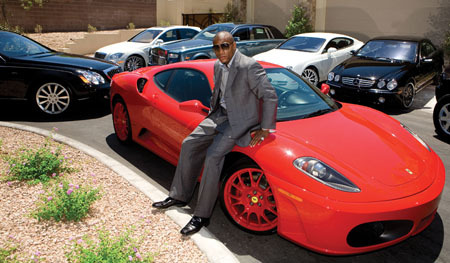
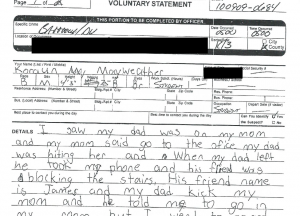
We all know that Floyd Mayweather Jr. is a disgusting excuse for a human being. If you don’t, just Google him and you’ll quickly get a picture. He has four children, but has never been married. The mother of three of them, Josie Harris, has gone on record about her horrific abuse. Worse still is that he beat her up in front of their oldest child, Koraun. Shantel Jackson, a woman he almost married, has also come forward about abuse. And, there have been others, several others. Yup, your all-around boy next door. That he became a boxer after his father and brothers is no surprise. That he suffered because his mother was a drug addict also does not surprise me.

But here’s what does – we condone his behavior in ways that border on criminal – such as aiding and abetting or accessory to a crime.

Both Wealth X and Celebrity Network now place his net worth at a healthy number above $300 Million. The income derived for this last event (a match against Manny Pacquiao) was sourced as having a live gate of approximately $74M and the pay-per-view sales at $400M (at an average per ticket price of $95, that comes to about 4.2M viewers).

So who is actually more disgusting – the animal that beats up women or the millions of people who pay to watch the fight and ignore, in fact REWARD this monster instead? He preys on women, yet walks free and lives in a 17,000 square foot home in Las Vegas. The one time he went to jail for a ridiculously short 87 day sentence, he was out in 60 days.

I have been a long-time dissenter for the amount of money we pay athletes in this country, the totals are obscene, but to pay a criminal like Mayweather and look the other way is just sick. Australia denied his permit to the country because of his criminal record; it’s a pity his own country doesn’t have as much sense.

0517-sunday-sports-page-3-628x415  Floyd-Mayweather-Jr-Ferrari-F430 Floyd-Mayweather-Jr.-Mansion-ICEDOTCOM7 11-year-old-Koraun-statement-300x216

Campaign Finance, a Political Cancer

I recently responded to an email regarding a political candidate. In return I received a ‘thank you’ along with a link to where I go could to make a contribution to that person’s campaign.

On some basic level, I was insulted…actually, no, I was kinda ticked off.

First of all, the people running for office are, by and large, wealthy individuals in their own right – this alone is a discordant fact. Secondly, why should I contribute to a campaign that’s virtually guaranteed to spend money on ads that ridicule the opposition instead of telling me in plain language what it is they would do if elected? Third, current laws allow virtually unlimited donations to Political Action Committees as a way round corporate and union funding caps, which is like handing out free crystal meth samples and offering mini-bottles of alcohol outside a rehab facility. Money and politics simply don’t mix – why have we not learned this by now?

Chief Justice John Roberts Jr. wrote that ‘there is no right in our democracy more basic than the right to participate in electing our political leaders.” This was his rationale behind why campaign finance limits should be all but eliminated, that in his view they violate First Amendment rights of free speech. It seems odd that a Supreme Court Judge could make the connection that money talks, and…well you know how that expression ends. Who said that an individual shouldn’t participate in an election? Why does that also have to mean that we soak our candidates in baths of liquid, free-flowing, hard-earned cash? The vast collection of news agencies could arrange their messages for free in the interest of democratic selection.

In the early years of the 20th Century, responsible laws were passed to help limit undue influence by the wealthy and those who lobbied for special interests, how much could be spent on campaigns, and allow for campaign finance transparency. In 1971, Congress consolidated these laws in the Federal Election Campaign Act (FECA). At the same time, there was a move to have campaigns financed by the government, as the alternative – it’s why you still see questions on your tax return about donating a dollar. Three years later, this was amended with additional spending limits and created the Federal Election Commission (FEC).

In 1975, the conservative Senator from New York, James Buckley, filed suit that the provisions of the FEC violated First Amendment rights to free speech and the due process considerations of the Fifth Amendment. As a result, the Supreme Court struck down limits on expenditures by candidates toward their own elections (which seems to freely offer an advantage to a wealthy individual running for office). It was the first step in the wrong direction.

Fast forward to 2009.

Citizens United – an organization with about as much common sense as The Tea Party – fought the Federal Election Commission over the decades old statutes that were put in place to safeguard against government corruption. This came about because they wanted to show a film called Hillary: The Movie during a time-frame that was prohibited under the old laws (within 60 days of a general election or 30 days of a primary). At stake were provisions covered under the First Amendment and political expenditures by non-profit corporations and their ability to contribute indirectly to campaigns – such as through the production of films.

There was considerable debate over this and the ruling came down in a close 5-4 vote. Justice Kennedy, in writing his majority opinion, took two wrong turns. The first was in the distinction that spending money is a variable of free speech; the second was that corporations, as an “association of individuals” should be afforded the same protections under the First Amendment. What the Judge failed to consider is that any time money is involved, those with more of it can artificially sway voters and second, that decisions corporations make about where to spend its money is governed by a small few at the top and not necessarily at the express wishes of the “association of individuals” as a whole. Further, corporations continue under the theory of a going concern, can therefore exist perpetually, tap into the accumulated wealth of years or even decades, and then those top decision makers can bring the resources under their control to bear in unduly influencing voters as they see fit. An individual whose voice ultimately dies with their passing and might not be able to summon such financial resources is therefore placed at an unfair disadvantage. The notion that preventing independent spending by corporations and unions as being a violation of the First Amendment has been twisted by those who attempt to sway public opinion to their own ends and agendas  – and profits.

Justice Stevens, in writing his dissent to these rulings, mentioned that the “We the People” principal should not extend to corporations which exist for profit. The favorable ruling “threatens to undermine the integrity of elected institutions across the Nation” and will contribute to the “appearance of corruption”. He had a point. Ask anyone on the street if they think the government is corrupt. The New York Times reported that the number of Americans convinced about corruption grew from 59% to 79% between 2006 and 2013. Stevens concluded his dissent by saying: “the Court’s opinion is thus a rejection of the common sense of the American people” and “While American democracy is imperfect, few outside the majority of this Court would have thought its flaws included a dearth of corporate money in politics.”

The most recent evidence of decay came just last April in yet another 5-4 Supreme Court decision. Justice Stephen G. Breyer said in his dissent that “If the court in Citizens United opened a door, today’s decision may well open a floodgate.” He was referring to the fact that individuals still have the $2,600 per candidate limit in primary and general elections, but they are now able to contribute $48,600 every two years to all federal candidates, and political action committees as much as $74,600. In essence, it presents the opportunity for “a single individual to contribute millions of dollars to a political party or to a candidate’s campaign.”

As a voter beginning to consider the next presidential election in 2016, it’s hard to imagine how these rulings have not and do not contribute to, if not exacerbate, the sharp divide between the parties, or the country as a whole. How much online rhetoric do we read that is devoted to the fact that the 1% controls the country and has driven an even greater wedge in its separation from the other 99%? Campaign finance has infected the election process with the internal appearance of a smoker’s blackened lungs.

If the person who wants to become the leader of the free world cannot figure a way to get there with nothing more than the goodwill of the people and without the vast amount of handouts from PACs, unions, and wealthy business people, does that person really deserve to be there in the first place? They’re certainly going to do it without my nickels.


Houston, we have a problem…

So first, a little context; some table setting as it were.

In January 1933, President Hindenburg of Germany reluctantly appointed Adolf Hitler as Chancellor – sort of a prime minister. A little less than two years later, Hindenburg died and Hitler grabbed the reins, declaring himself Germany’s leader (der Führer). In short order, he bloomed as the popular leader by helping his people overcome the disastrous effects of the American economic depression (it hit them, too) and mollifying Germany’s sense of humiliation over the Versailles Treaty at the end of World War I.

In March 1938, Hitler declared the Austrian Anschluss, effectively bringing control of the German speaking nation under control of the Third Reich. A short time later, they annexed the Sudetenland which included areas of German speaking people of the Czech Republic. Britain, of course, made fists and stamped their feet condemning Hitler for this act. Privately, British Prime Minister Chamberlain urged the Czechs to allow the concessions because England was in no position to lend military assistance. Chamberlain goes to visit Hitler attempting to secure a peace. Hitler gives his assurances, but by March 1939, he invades Czechoslovakia anyway, and seizes the provinces of Bohemia and Moravia – they were populated by an overwhelming populace of German speaking people. Britain is still posturing with condemnations, but assures Poland that if German were to invade, they would come to their aid. Of course on September 1, 1939, Germany launches Blitzkrieg and rolls through Poland. Two days later, WWII is on.

Keep the foregoing in mind…

Today, there are many dire geopolitical events, each of which may not seem like the end of the world, but you will notice some significant cause for alarm looking through a magnifying glass and focusing on the patterns.

First, the biggest threat: Russia, and more specifically Vladimir Putin. He recently regained his position as President of Russia in May 2012. He had previously held that post for eight years, but this time it appears there will be no attempt to hide his imperialistic agenda. In March 2014, the Russian Federation annexes the Ukrainian territory of Crimea – it was populated by an overwhelming populace of Russian speaking people – then holds an election which suggests their willingness to be taken under Russia’s wing. NATO makes fists and stamps their feet in condemnation. Sound familiar?

In 2014 there was a revolution in Ukraine. Many wanted to sign up with NATO, but of course that wouldn’t sit well with Putin, so as we continue to see, there is great military tension between Russia and Ukraine. You can see where that’s heading – Russian manifest destiny anyone?

Now let’s peel back a layer of the onion dome atop St. Basil’s Cathedral.

Since 1996, Russia and China have had certain accords which were amended from time to time, the last being in 2001 when the five member countries of the alliance admitted Uzbekistan to their midst. In 2002 they all met in Russia and renamed themselves the Shanghai Cooperation Organization. Essentially, they will work together on security, especially on fighting extremist Islamic fundamentalist organizations, economic issues, cultural exchanges, and last but not least military activities. I will come back to this in a moment.

Next we see that Russia is engaging with Iran to barter oil and weapons (such as the S-300 missile rocket system) for grain, equipment, and construction materials, just as the west is dealing with Iran on its nuclear program. Now, the United States is dangling a $50 Billion dollar bonus in front of Iran if and when they sign the deal. (In essence, we would be subsidizing both Iran and Russia). Plus there is the fact that more billions of dollars will be freed up for Iran once the economic sanctions are lifted. This will create a new threat against U.S. allies such as Israel and Saudi Arabia, while Russia pockets yet another new one – and a better armed one.

It gets better.

Vladimir Putin has invited Kim Jong Un of North Korea to Moscow for the May 9th celebration of the USSR victory over the Nazis. Wouldn’t you just love to be a fly on the wall when they cozy up for a little coffee and conversation inside the Kremlin?

Now, just for kicks let’s take a quick look at why I mentioned the military cooperation between Russia and China. If you add Russia, China, and North Korea together, you have a combined military strength of 13,000,000. If we add the UK, France, Saudi Arabia, South Korea, Japan (who technically doesn’t have a military), and Germany to our own forces, we have 7,600,000. Yes, we currently outnumber the rest of the world in aircraft carriers, destroyers, fighter jets, and armored fighting vehicles, but it’s been recently reported that China is undergoing a major naval build-up. Russia has also put ships in the “once-secret naval base” in Olavsvern, Norway. Establishing a presence on the Scandinavian coastline puts them one step closer to the North Atlantic corridor and in closer striking distance to Canada and North American. It doesn’t involve a great deal of imagination to picture a coordinated pincer attack from the northeast, west, and northwest, especially while we’re struggling with Islamic terrorists in several different countries and have only one eye on the rest of the world.

I’ll get to nukes in a second.

Is anyone crazy enough to believe that war, even a world war, is beyond our so highly developed sense of humanity? No, I didn’t think so. If you split the NATO allies up on a multi-front war, how long will our few advantages last? The only way to begin balancing things in our favor is to make an alliance with India who has more than 3.5 million in their military and a rudimentarily decent navy – but, as of now, they are not a member of NATO. One also has to consider which way the wind will blow for Pakistan, Afghanistan, Iraq, and Israel.

Lastly, there IS the question of nuclear weapons. We’ve got ‘em and Russia’s got ‘em – about 5,000 each (well a little less, but not by much – at that point, what difference does it make?). We’ve pretty much lived in a MAD (mutually assured destruction) world since the 1950s. But there are wild cards now. We’re trying to keep Iran out of the picture, but China has around 250 nukes, North Korea has 10, and Pakistan has 120. Combined, the UK, France, and India have another, say, 600. Israel, who was duplicitous in the 1960’s about their nuclear weapons program, has some number between 60 and several hundred. To my way of thinking, if things get really tied up for the United States and NATO, and Israel finds itself with enemies coming from all directions – Egypt, Jordan, Syria, Saudi Arabia, and Iran (especially if they overrun Saudi Arabia and sweep up the Red Sea coast) what would prevent Israel from resorting to a last-ditch measure and retaliate with a nuke or two. It’s not like it hasn’t been done before. (Yeah, I know, at the time we were the only ones to have them, but the reasoning was pretty much the same.) It’s pretty common knowledge that with a phone call Saudi Arabia can pick up a few nukes from Pakistan. I can see the heat of the Middle East getting hotter in a hurry.

Of course this all sounds a bit like a doom-sayer foaming at the mouth, but the people who sat by and said Germany’s not my problem during the 1930s, and those who simply issued verbal condemnations, woke up when it was already too late, at which point the world was on course for the deaths of 60 million people. By today’s standards, that would equate to 210 million. I have a feeling it would be a lot worse.

We’ve got to keep our eyes open. Consider the state of the world when it comes time for the election next year. If you combine our domestic problems with a world that is edging closer and closer to a multi-national conflict (a euphemism for WWIII), then this presidential election might very well be the most important one in our lifetimes.

Or maybe our last…